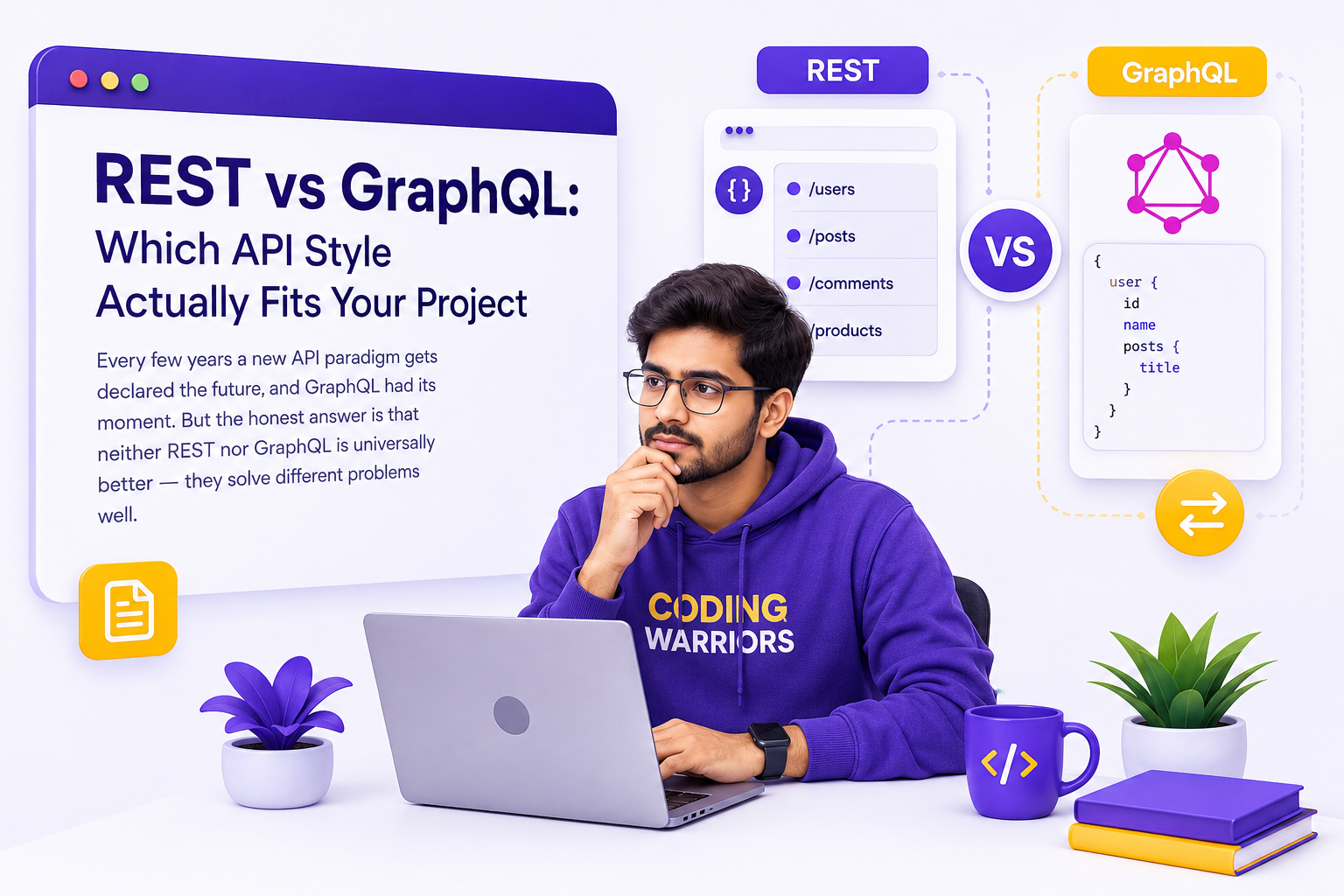
Every few years a new API paradigm gets declared the future, and GraphQL had its moment. But the honest answer is that neither REST nor GraphQL is universally better — they solve different problems well.
When REST still wins
REST is simple, cacheable, and every developer already understands it. If your API has predictable resources — users, orders, products — and clients generally need the full object, REST keeps things straightforward. HTTP caching, CDN support, and tooling are all mature and battle-tested.
When GraphQL earns its complexity
GraphQL shines when clients have wildly different data needs — a mobile app that needs a lean payload versus a dashboard that needs deeply nested data. Instead of building five different REST endpoints or over-fetching data, a single GraphQL query lets each client ask for exactly what it needs.
The real cost nobody mentions
GraphQL moves complexity from the client to the server. You need to think about query depth limits, N+1 query problems, and caching strategies that don't come for free like they do with REST. It's a real engineering investment, not just a syntax choice.
Our rule of thumb
If you're building a straightforward CRUD-heavy application with a handful of client types, REST will get you there faster with less operational overhead. If you're supporting many different clients with very different data shapes — web, mobile, third-party integrations — GraphQL's flexibility starts paying for itself.
The wrong choice isn't picking REST or GraphQL — it's picking one because it's trendy instead of because it fits how your clients actually consume data.
R
Rohan Mehta
Written at Coding Warriors